
ACCESS
EXPLORE
CONTINUE
Offline Maps for
Visitor Attractions
Help visitors keep exploring – even without Wi-Fi.
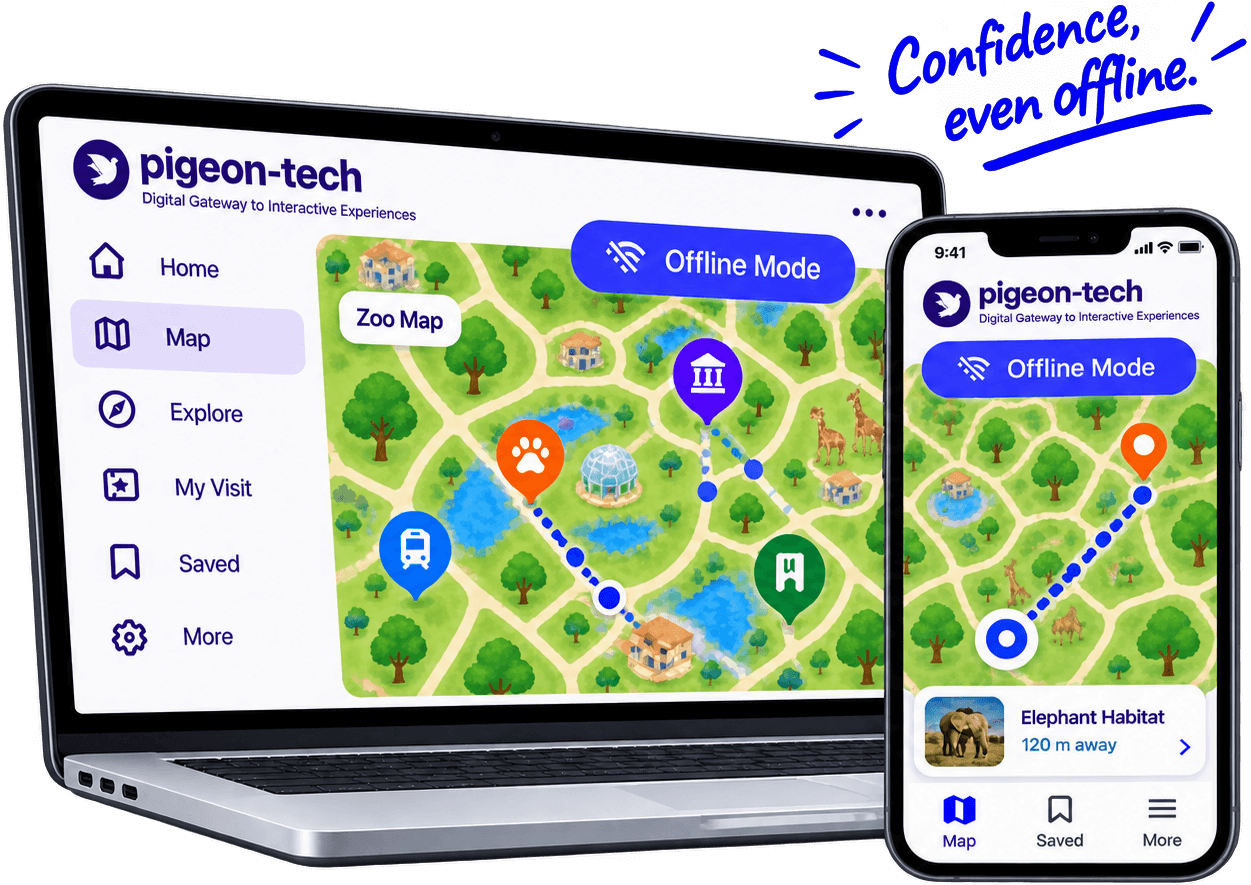
From downloaded content to confident visitor navigation
A simple offline-ready experience helps visitors stay oriented even when internet access is weak or unavailable.
Load Content
Maps, routes, and key visitor information are made available in the app.
Explore Offline
Visitors can continue using supported maps and content without relying on Wi-Fi.
Reconnect & Sync
When connectivity returns, the experience can refresh and stay up to date.
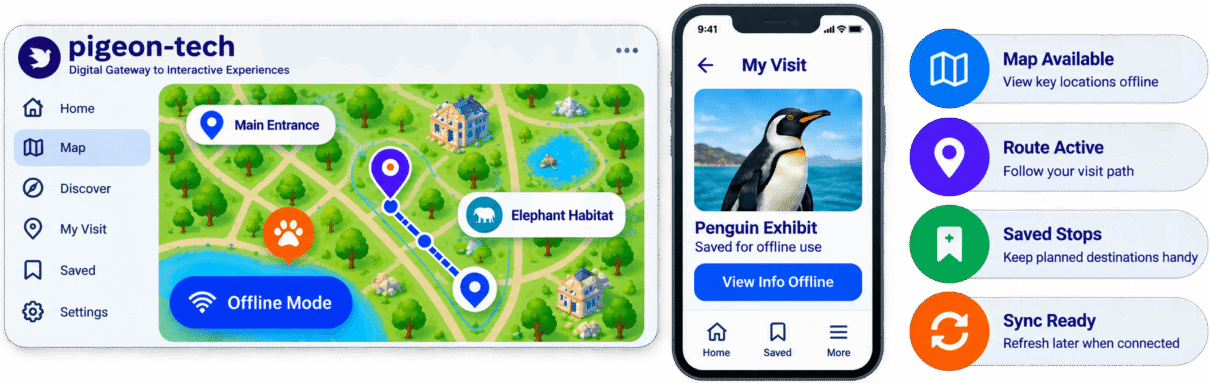
Core offline capabilities for your venue
Compact, powerful feature capabilities designed for real venue needs.
Offline Maps
Keep venue maps accessible without a live connection.
Route Guidance
Help visitors follow paths, zones, and key destinations.
Saved Content Access
Support access to selected content during the visit.
Route Guidance
Refresh content and updates when connectivity is available.
A reliable experience visitors can keep using
Value for Visitors and Venue Teams
For Visitors
For Venue Teams
Explore Related Pigeon-Tech Experiences
Cached analytics sync
Guided walking directions
Offline translated guides
Branded offline experience
See Offline Maps in Action
Frequently Asked Questions
An offline map is a digital map that visitors can access on their device without relying on an active internet connection.
With Pigeon-Tech, offline map functionality can support venue navigation and access to configured visitor content in locations where Wi-Fi or mobile data may be weak, inconsistent, or unavailable.
This is especially useful for museums, zoos, aquariums, theme parks, trails, outdoor attractions, remote destinations, and other visitor environments where connectivity can vary.
Pigeon-Tech offline access is designed so supported app content is available on the device after it has been prepared for the visitor experience.
Depending on the deployment, visitors can continue using configured app features even when connectivity is limited or unavailable.
When connectivity returns, supported content or data can refresh or synchronize according to the application configuration.
The exact offline behavior should be defined during implementation so the venue knows which content and interactions remain available without a network connection.
Depending on the configured experience, visitors may be able to access:
1. Interactive maps
2. Routes and visitor navigation
3. Exhibit or attraction information
4. Saved content
5. Tours and trails
6. Educational content
7. Images, audio, or video prepared for offline use
8. Quizzes or treasure hunt activities
9. Multilingual content
10. Other supported app features
The content available offline depends on what has been included in the application and prepared for offline access.
This should be confirmed for each deployment rather than assuming every external service or integrated feature will work without connectivity.
No. Once the required offline content is available on the device, visitors can access supported offline maps and content without an active Wi-Fi or mobile-data connection.
Internet connectivity may still be required for activities such as:
1. Initial app download
2. Content updates
3. Synchronization
4. External web pages
5. Third-party services
6. Live information that depends on an online source
The offline experience should be designed so visitors can continue using the features that matter most during their visit.
Yes. Offline map experiences can support both indoor and outdoor visitor environments.
For example, they can be useful in:
1. Museums and galleries
2. Zoos and aquariums
3. Theme and water parks
4. Trails and nature centers
5. Heritage sites
6. Fairs and festivals
7. Remote tourism destinations
8. Large campuses and outdoor attractions
The map, routing, positioning, and content configuration should be designed around the specific venue.
Explore Digital Wayfinding
When connectivity becomes available again, supported app content can refresh or synchronize according to the application configuration.
Depending on the deployment, this may include:
1. Updated venue content
2. Changed exhibit or attraction information
3. New events or schedules
4. Updated maps
5. New multilingual content
6. Analytics or interaction data waiting to synchronize
The refresh behavior depends on how the application is configured and which features require connectivity.
Yes. Offline capability can be designed to support other Pigeon-Tech visitor experiences where the required content and functionality are available on the device.
Depending on the deployment, this may include:
1. Interactive maps
2. Digital wayfinding
3. Multilingual content
4. Tours and trails
5. Educational content
6. Treasure hunts
7. Quizzes
8. Exhibit information
9. Saved visitor content
Some features that rely on live third-party systems, external data, or network-based services may require connectivity.
The offline scope should therefore be defined as part of the overall visitor experience design.
Yes. Pigeon-Tech can provide offline visitor functionality as part of a white-labeled application using the venue’s own branding.
The visitor experience can use the organization’s:
1. Logo
2. Colors
3. Navigation
4. Content
5. Maps
6. Offline visitor information
This allows the offline experience to remain part of the venue’s branded digital journey rather than feeling like a separate tool.
Explore White-Label Visitor Apps
Supported offline interactions can be recorded locally and synchronized when connectivity becomes available, depending on the analytics configuration and the feature involved.
This may include activity such as:
1. Map interactions
2. Content views
3. Navigation selections
4. Quiz or treasure hunt participation
5. Other configured engagement events
The exact events that can be captured and synchronized should be confirmed during implementation.
Explore Visitor Analytics
An offline map allows visitors to view venue locations and map information without internet access.
Offline navigation goes further by helping visitors follow configured routes or directions while they are offline.
In Pigeon-Tech, the exact offline navigation experience depends on the map, routing configuration, and positioning method used for the venue.
